
Validating how we can redefine open science business models
Validating how we can redefine open science business models
As part of our Redefining Publishing initiative, funded by the Robert Wood Johnson Foundation and the Gordon & Betty Moore Foundation, we’re exploring how publishing can evolve to support open science more equitably and sustainably.
This spring, we heard from research libraries, consortia, funders, and institutional leadership across Europe, North America, and Asia. Through a convening in March 2025 and follow-up interviews with PLOS’s institutional partners worldwide, we’re exploring how scholarly communication business models can move beyond article processing charges (APCs) and better align with open science.
Why move beyond the APC?
The Redefining Publishing initiative builds on a long-held goal at PLOS: to expand access to knowledge and increase participation in knowledge creation. Alongside our efforts to shift recognition beyond the article, we aim to develop a model grounded in equity and transparency that enables greater participation in open science and delivers long-term sustainability.
Participants at our March convening described current business models as "fundamentally broken." APCs place disproportionate financial strain on institutions, widen global inequities, and fail to account for the range of outputs and contributors to open science.
- Broaden participation in open science.
- Enable recognition for all contributors.
- Shift cost responsibility away from individual researchers.
- Replace, not add to, current spending on publishing.
What a future business model must deliver
/PLOS-brand-image-full-waves-scaled_1500x1500.jpeg?width=400&height=400&name=PLOS-brand-image-full-waves-scaled_1500x1500.jpeg "PLOS-brand-image-full-waves-scaled_1500x1500")
Stakeholders agree that our new model must:
- Recognize the full range of outputs and services connected with open science, not just articles.
- Support research assessment reform by tracking and crediting a wider range of outputs and the individuals contributing.
- Provide an equitable, transparent service that is predictable for institutions or funders.
- Work across regions and disciplines, considering different policy environments.
- Consider future needsfor interoperability, automation or AI use.
How can this be achieved?
PLOS is building on what we have learned from existing open access business models, including APCs, Community Action Publishing, Subscribe to Open, Publish and Read agreements, and fully-supported/sponsored models.
While there is strong support among stakeholders for new approaches, we know from experience what successful adoption will require:
- Understanding how the model can work across regions, acknowledging the diverse policy environments and availability of funding.
- Communicating the clear value of the model to institutions, compared with existing models.
- Backwards compatibility: new systems must work with the current infrastructure and researcher workflows.
- Ensuring adoption readiness, including researcher demand, which differs by discipline and geography.
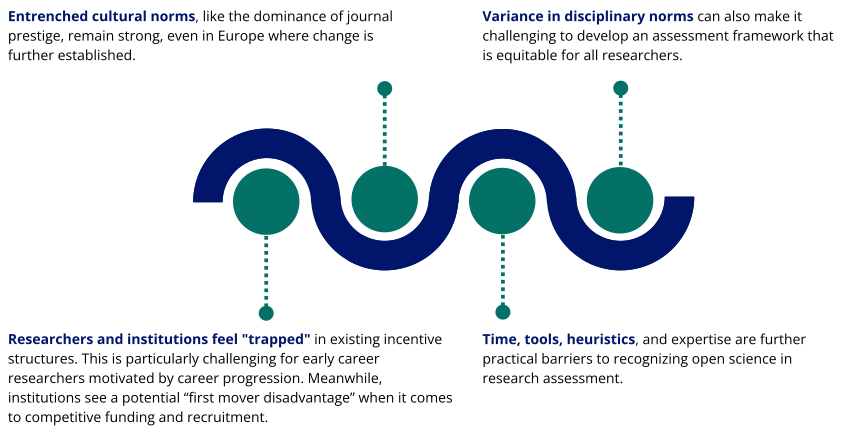
Entrenched cultural norms, like the dominance of journal prestige, remain strong, even in Europe where change is further established.
Variance in disciplinary norms can also make it challenging to develop an assessment framework that is equitable for all researchers.
Researchers and institutions feel "trapped" in existing incentive structures. This is particularly challenging for early career researchers motivated by career progression. Meanwhile, institutions see a potential “first mover disadvantage” when it comes to competitive funding and recruitment.
Time, tools, heuristics, and expertise are further practical barriers to recognizing open science in research assessment.
Variance in disciplinary norms can also make it challenging to develop an assessment framework that is equitable for all researchers.
Researchers and institutions feel "trapped" in existing incentive structures. This is particularly challenging for early career researchers motivated by career progression. Meanwhile, institutions see a potential “first mover disadvantage” when it comes to competitive funding and recruitment.
Time, tools, heuristics, and expertise are further practical barriers to recognizing open science in research assessment.
Support for the knowledge stack
"What you are proposing is what the future of science should look like. PLOS are the right people to be doing this."
Participants in our stakeholder research and convenings have endorsed the knowledge stack as a promising innovation that could help disrupt the current article-centric model of research assessment. Some even likened it to earlier publishing innovations, like DOIs and ORCID, that eventually reshaped researcher behavior.
Several key findings from our initial convening were further supported:


There are many questions to resolve as the knowledge stack design progresses, notably around trust signals and quality control for non-article outputs, and how to ensure compatibility with the broader scholarly infrastructure.
What’s next?
We’re continuing to build on this input to refine our model, and further engagement with institutions, consortia, and funders is underway to understand regional variation in particular. To have your say, or to hear more about the project, get in touch.